Table of Contents
- The Complete Guide to QR Code Analytics and Performance Tracking
- What Is QR Code Analytics?
- Why Performance Tracking Matters
- Static QR Codes vs Dynamic QR Codes for Analytics
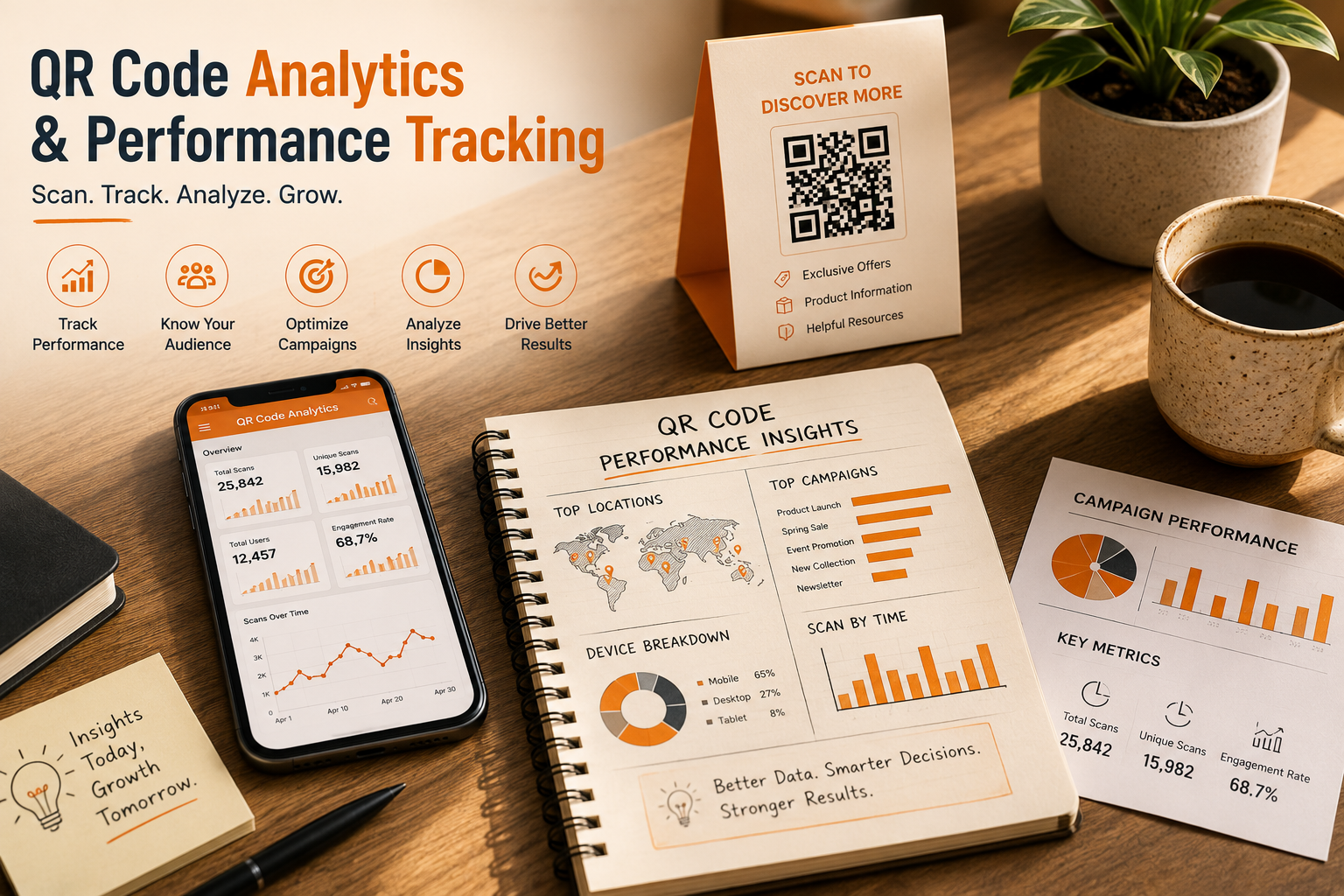
- Key Metrics Every Business Should Monitor
- How Analytics Supports Better Business Decisions
- Tracking Customer Locations and Devices
- Understanding Customer Behaviour Through Scan Data
- Measuring Campaign Performance Across Multiple Channels
- Measuring Return on Investment (ROI)
- Common Mistakes That Limit QR Code Performance
- Best Practices for Improving QR Code Performance
- Turning Analytics Into Continuous Business Growth
- Conclusion
The Complete Guide to QR Code Analytics and Performance Tracking
QR codes have evolved from simple tools for sharing website links into powerful business assets that support marketing, customer engagement, product information, digital payments, and business communication. Today, businesses across industries use QR codes to connect offline experiences with digital content, making it easier for customers to access information instantly with a simple smartphone scan. However, while creating and sharing QR codes is relatively straightforward, understanding how they perform after they are deployed is what truly determines their value. Without measuring performance, businesses have no clear way of knowing whether their QR code campaigns are reaching the right audience, encouraging engagement, or contributing to their business goals.
Modern marketing is driven by data rather than assumptions. Every campaign, advertisement, product launch, and customer interaction generates valuable information that helps businesses understand what works and where improvements can be made. QR code analytics brings this same data-driven approach to QR code campaigns by providing detailed insights into how customers interact with QR codes. Instead of simply hoping people scan a code, businesses can monitor scan activity, identify customer preferences, evaluate campaign performance, and make informed decisions based on real user behaviour.
Performance tracking has become increasingly important because customer journeys are now more complex than ever. A customer may discover a product through a printed brochure, scan a QR code on a retail display, visit a landing page, compare products online, return later using another device, and eventually complete a purchase. Every one of these interactions provides useful information that businesses can analyse to improve future campaigns. QR code analytics helps transform each scan into meaningful business intelligence, allowing organizations to understand customer engagement at every stage of the journey.
Dynamic QR Codes have made analytics even more valuable by enabling businesses to update content while continuously collecting performance data. Instead of replacing printed QR codes whenever campaigns change, businesses can keep using the same QR code while monitoring customer interactions over time. This combination of flexibility and measurable insights allows companies to optimize marketing efforts, improve customer experiences, and achieve better returns on their investments.
As competition continues to increase across industries, businesses that rely on measurable results rather than guesswork are better positioned to grow. QR code analytics provides the visibility needed to understand customer behaviour, evaluate campaign effectiveness, and continuously improve communication strategies. It is no longer enough to know that a QR code exists; businesses need to understand how well it performs and how those insights can support smarter decision-making.
What Is QR Code Analytics?
QR code analytics is the process of collecting, measuring, and analysing data generated when people scan a QR code. Every scan represents a customer interaction, and modern analytics platforms convert these interactions into valuable reports that help businesses understand how their QR codes are performing.
Unlike traditional printed advertisements, where measuring customer engagement can be difficult, QR codes create direct digital interactions that can be tracked and analysed. Businesses can monitor how often a QR code is scanned, when scans occur, where customers are located, which devices they use, and which campaigns generate the highest engagement. These insights provide a clearer picture of customer behaviour while helping organizations make evidence-based marketing decisions.
Analytics transforms QR codes from simple access tools into intelligent business resources. Rather than guessing whether customers noticed a product display or responded to a printed advertisement, businesses receive measurable data that highlights real customer activity. This information becomes increasingly valuable as organizations expand their marketing efforts across multiple locations, products, and customer segments.
By continuously monitoring QR code performance, businesses can identify successful campaigns, improve weaker ones, and allocate marketing resources more effectively.
Why Performance Tracking Matters
Creating a QR code is only the first step. The real value comes from understanding how customers interact with it after it has been published. Performance tracking allows businesses to measure success, identify opportunities for improvement, and ensure that every marketing effort contributes to meaningful business outcomes.
Without analytics, businesses may never know whether customers are scanning their QR codes or whether the linked content is providing value. A beautifully designed product package, brochure, or advertisement may include a QR code, but if very few people scan it, businesses need to understand why. Perhaps the QR code is difficult to find, the call-to-action is unclear, or the landing page fails to meet customer expectations. Analytics helps answer these questions with measurable data instead of assumptions.
Performance tracking also enables businesses to compare different campaigns. For example, a retailer running promotions across multiple store locations can evaluate which stores generate the highest number of scans. A manufacturer can compare customer engagement across different product lines, while an event organizer can measure which promotional materials attract the greatest attention. These insights allow businesses to improve future campaigns while maximizing marketing efficiency.
As customer expectations continue evolving, organizations that regularly monitor and improve their QR code performance will remain more competitive than those relying solely on intuition.
Static QR Codes vs Dynamic QR Codes for Analytics
Understanding the difference between Static QR Codes and Dynamic QR Codes is essential when discussing performance tracking. While both types allow customers to access digital information through a scan, only one provides the flexibility and analytical capabilities needed for modern business operations.
Static QR Codes contain fixed information that cannot be changed after they are created. Once printed, the destination remains permanent. Because of this limitation, businesses have very little visibility into how the QR code performs over time. If product information changes or marketing campaigns evolve, a completely new QR code must usually be generated and printed.
Dynamic QR Codes offer a much more advanced solution. Instead of storing the final destination directly within the QR code, they connect to a manageable digital link that can be updated whenever necessary. More importantly, Dynamic QR Codes provide access to analytics that helps businesses monitor scan activity, evaluate customer engagement, and measure campaign performance.
This flexibility allows organizations to update landing pages, promotions, documents, videos, or product information without changing the printed QR code. At the same time, businesses continue collecting valuable performance data that supports ongoing optimization and long-term marketing success.
For businesses seeking measurable results and continuous improvement, Dynamic QR Codes have become the preferred choice.
Key Metrics Every Business Should Monitor
Successful QR code campaigns are built on more than simply counting scans. Businesses need to understand multiple performance indicators that together provide a complete picture of customer engagement. Monitoring these metrics helps identify strengths, uncover opportunities for improvement, and support more informed business decisions.
Some of the most valuable metrics include:
- Total Scan Volume: Shows how many times a QR code has been scanned, helping businesses measure overall engagement and campaign reach.
- Unique Scans: Distinguishes between first-time users and repeat visitors, providing a clearer understanding of audience size.
- Scan Frequency Over Time: Reveals how engagement changes daily, weekly, or monthly, helping businesses evaluate campaign performance and seasonal trends.
- Location-Based Activity: Shows where scans are occurring, allowing organizations to compare performance across different cities, stores, events, or regions.
- Device and Operating System Information: Helps businesses understand which smartphones and platforms customers use, supporting better mobile optimization.
- Landing Page Performance: Measures how effectively the destination page converts customer interest into meaningful actions such as registrations, purchases, or enquiries.
Together, these metrics provide a comprehensive view of campaign effectiveness while helping businesses continuously improve customer experiences.
How Analytics Supports Better Business Decisions
Every business decision becomes stronger when supported by reliable data. QR code analytics provides measurable insights that help organizations move beyond assumptions and make improvements based on actual customer behaviour.
For example, if analytics shows that one product consistently receives significantly more scans than others, businesses can investigate what makes that product more attractive and apply similar strategies elsewhere. If a marketing campaign generates many scans but few conversions, the issue may lie with the landing page rather than the QR code itself. If customers frequently scan during certain times of the day, promotional activities can be scheduled to maximize engagement.
Analytics also helps businesses evaluate return on investment. Instead of simply measuring the number of printed brochures distributed or advertisements displayed, organizations can track actual customer interactions and determine which campaigns produce meaningful results. This level of visibility allows marketing budgets to be allocated more effectively while reducing unnecessary spending on underperforming initiatives.
Over time, continuous analysis creates a cycle of improvement. Businesses learn from every campaign, refine their strategies, and build stronger customer experiences based on real-world performance rather than guesswork. This data-driven approach is one of the key reasons why QR code analytics has become an essential part of modern marketing and digital transformation.
Tracking Customer Locations and Devices
One of the greatest advantages of QR code analytics is the ability to understand where and how customers interact with your QR codes. Every scan provides valuable information that helps businesses evaluate the effectiveness of their marketing campaigns across different locations, customer segments, and devices. Rather than relying on estimates, businesses gain measurable insights into customer engagement, allowing them to make smarter marketing decisions.
Location tracking helps businesses identify the geographical areas generating the highest level of engagement. For example, a retailer operating stores in multiple cities can compare scan activity across each location to understand where promotional campaigns are performing best. Event organizers can determine which exhibition booth attracted the most visitors, while manufacturers can analyse which distribution regions generate the highest product engagement. This information enables businesses to allocate marketing resources more effectively while identifying new growth opportunities.
Device tracking is equally valuable because it reveals the types of smartphones, operating systems, and devices customers use when scanning QR codes. Understanding whether customers primarily use Android devices, iPhones, tablets, or other mobile platforms helps businesses optimize their digital experiences. Landing pages, websites, videos, and forms can then be designed to perform smoothly across the devices customers actually use, resulting in a better overall user experience.
When combined, location and device analytics provide businesses with a clearer understanding of customer behaviour while supporting continuous improvements in both marketing and customer communication.
Understanding Customer Behaviour Through Scan Data
Every QR code scan tells a story about customer behaviour. While the number of scans provides a useful starting point, analysing patterns over time offers much deeper insights into how customers discover, explore, and interact with a business.
For example, businesses may notice that scan activity increases during weekends, holiday seasons, or special promotional events. Certain products may consistently receive more attention than others, while specific campaigns may attract new customers more effectively than expected. By identifying these trends, businesses can refine their marketing strategies to better align with customer interests and buying habits.
Scan frequency also helps distinguish between one-time visitors and returning customers. Repeat scans often indicate ongoing interest, whether customers are accessing product information, returning to educational resources, or revisiting promotional offers. These recurring interactions suggest stronger customer engagement and can help businesses identify opportunities to build longer-term relationships through loyalty programs, exclusive content, or personalized communication.
Customer behaviour analysis also highlights areas where improvements may be needed. If a QR code receives many scans but very few customers continue to complete registrations, purchases, or enquiries, the problem may not be the QR code itself but the landing page experience. Analytics enables businesses to identify these issues quickly and implement improvements that increase conversion rates.
Measuring Campaign Performance Across Multiple Channels
Modern marketing campaigns rarely rely on a single communication channel. Businesses promote products through printed brochures, newspapers, retail displays, product packaging, exhibitions, outdoor advertising, email campaigns, social media, and direct mail. QR codes can be integrated into each of these touchpoints, making it possible to measure performance across the entire marketing ecosystem.
For instance, a company launching a new product may place different Dynamic QR Codes on magazine advertisements, product packaging, trade show banners, and digital presentations. By monitoring the analytics for each QR code, the marketing team can compare which channel generates the highest engagement and which audience responds most positively.
This information helps businesses optimize future campaigns. Instead of investing equally across every marketing channel, they can focus resources on the platforms delivering the strongest results. If a printed brochure generates significantly more scans than a billboard, future budgets can be adjusted accordingly. Likewise, if exhibition visitors interact more with QR codes than website visitors, businesses can create more interactive event experiences.
Campaign-level analytics remove uncertainty from marketing decisions, enabling organizations to invest with greater confidence and achieve stronger returns.
Measuring Return on Investment (ROI)
Every business wants to know whether its marketing investments are producing meaningful results. QR code analytics plays an important role in measuring return on investment by connecting customer interactions with business outcomes.
Rather than evaluating success based solely on the number of printed materials distributed or advertisements displayed, businesses can measure actual engagement through scan activity. If a promotional campaign generates thousands of scans and a significant percentage of users complete purchases, register for events, or request additional information, the campaign clearly demonstrates measurable value.
ROI analysis becomes even more useful when businesses compare multiple campaigns over time. A product launch, seasonal promotion, educational campaign, or customer loyalty initiative can each be evaluated using consistent performance data. Marketing teams can identify which strategies produce the highest engagement while reducing investment in less effective activities.
This evidence-based approach improves financial decision-making while helping businesses maximize the impact of future marketing campaigns.
Common Mistakes That Limit QR Code Performance
Although QR codes are simple to implement, many businesses fail to achieve their full potential because of avoidable mistakes. Understanding these challenges helps organizations create better customer experiences while improving campaign performance.
One common mistake is placing QR codes without explaining their purpose. Customers are much more likely to scan when they know exactly what they will receive, whether it is a product video, exclusive discount, user guide, event registration, or special offer.
Another issue is directing users to poorly designed landing pages. Even if customers scan the QR code successfully, a slow-loading website or confusing interface may cause them to leave immediately. Businesses should ensure that every destination page is mobile-friendly, easy to navigate, and delivers genuine value.
Some organizations also overlook the importance of testing QR codes before printing them. A damaged link, incorrect destination, or scanning issue can negatively affect the entire campaign. Regular testing ensures a consistent customer experience.
Finally, many businesses collect analytics but fail to use the insights they receive. Performance data only becomes valuable when it leads to improvements in marketing strategies, customer communication, and overall business operations.
Best Practices for Improving QR Code Performance
Businesses that consistently achieve strong results with QR code campaigns usually follow a structured approach to performance optimization. Instead of treating QR codes as one-time marketing tools, they continuously monitor analytics, evaluate customer behaviour, and refine their strategies over time.
Some practical best practices include:
- Use Dynamic QR Codes whenever campaigns or content may change.
- Place QR codes in locations where customers can easily notice and scan them.
- Add a clear call-to-action explaining the benefit of scanning.
- Ensure landing pages load quickly and are fully optimized for mobile devices.
- Review analytics regularly to identify successful campaigns and opportunities for improvement.
- Test QR codes before publishing them across any marketing material.
- Update linked content frequently to keep customer experiences fresh and relevant.
- Compare campaign performance across different channels to improve future marketing investments.
By following these recommendations, businesses can create QR code campaigns that not only generate more scans but also deliver meaningful customer engagement and measurable business value.
Turning Analytics Into Continuous Business Growth
The true value of QR code analytics is not simply collecting data—it is using that data to make better decisions. Every scan provides an opportunity to learn more about customer preferences, improve marketing campaigns, and enhance the overall customer experience.
Businesses that review performance regularly can identify successful strategies more quickly, respond to changing customer behaviour, and continuously refine their communication efforts. Over time, this creates a cycle of ongoing improvement where each campaign becomes more effective than the last.
As digital engagement continues to grow, organizations that embrace analytics as part of their everyday decision-making process will be better prepared to adapt to market changes, improve customer satisfaction, and strengthen long-term business performance.
Conclusion
In today's competitive digital environment, creating QR codes is only the beginning of building successful customer experiences. The real advantage comes from understanding how those QR codes perform after they are deployed. Every scan represents an opportunity to learn something valuable about customer behavior, campaign effectiveness, and business performance. Organizations that consistently monitor these interactions gain meaningful insights that help them improve marketing strategies, strengthen customer engagement, and make more informed business decisions.
QR code analytics transforms simple scans into actionable business intelligence. Instead of relying on assumptions, businesses can measure real customer interactions, compare marketing channels, identify high-performing campaigns, and understand how customers engage with products and services across different locations and devices. This data-driven approach enables continuous improvement, allowing organizations to optimize every stage of the customer journey while maximizing the return on their marketing investments.
Dynamic QR Codes make performance tracking even more powerful by combining flexibility with detailed analytics. Businesses can update digital content instantly without changing printed QR codes while continuing to collect valuable performance data over time. Whether introducing a new product, launching a seasonal campaign, updating product documentation, or improving customer support, Dynamic QR Codes ensure customers always receive the latest information while businesses maintain complete visibility into campaign performance.
Beyond marketing, QR code analytics supports smarter business planning. The insights gathered through scan reports help organizations identify customer preferences, evaluate regional performance, improve mobile experiences, and allocate resources more effectively. Instead of making decisions based on guesswork, businesses gain the confidence to invest in strategies backed by measurable results. This creates a continuous cycle of learning, improvement, and innovation that helps organizations remain competitive in an increasingly digital marketplace.
As customer expectations continue evolving, businesses that embrace analytics will be better prepared to deliver personalized experiences, improve communication, and respond quickly to changing market conditions. QR code analytics is no longer simply a reporting feature—it has become an essential part of building intelligent marketing campaigns, improving operational efficiency, and creating stronger customer relationships.
If your organization is looking for a reliable way to measure QR code performance while maintaining the flexibility to adapt as your business grows, QR Orange offers powerful Dynamic QR Code solutions with advanced analytics and performance tracking. From monitoring scan activity and customer engagement to optimizing campaigns with real-time insights, QR Orange helps businesses turn every scan into meaningful data that supports smarter decisions, stronger customer experiences, and sustainable long-term growth.